
Table of Contents
The Fed’s October meeting runs October 27 to 28, with the decision due on Wednesday, October 28. The federal funds rate is 3.75% to 4% after the Fed raised rates in September for the first time in more than three years. Markets see about an 80% chance the Fed holds rates steady in October, with a hike widely expected in December. Inflation rose to 3.7% in September, driven mainly by energy prices, while job growth slowed sharply. Higher Fed rates usually mean higher costs for credit cards and loans, but better returns on savings.
The Federal Reserve meets this week, and for the first time in years, the big question is not whether it will cut interest rates but whether it will raise them again.
The Fed meeting October 2026 runs over two days, October 27 and 28, with the decision announced on Wednesday afternoon. Most investors expect the central bank to leave rates where they are for now. But with inflation rising again, a surprise is not off the table.
Here is what to expect from the Fed meeting October 2026, the latest economic data shaping the decision, and what it could mean for your mortgage, credit card and savings account.
When Is the Fed Meeting in October 2026?
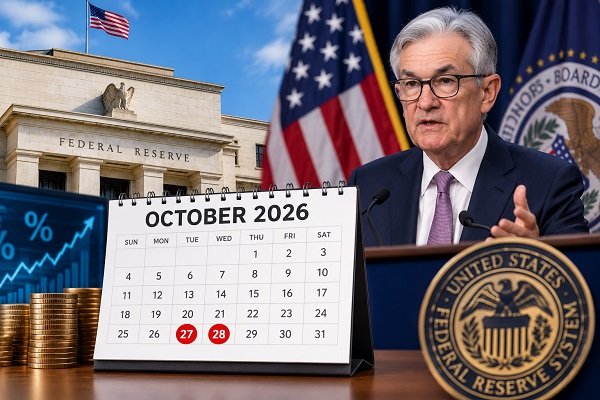
The Federal Open Market Committee, the group that sets US interest rates, meets on Tuesday, October 27, and Wednesday, October 28, 2026.
The Fed usually releases its decision at 2 p.m. Eastern Time on the final day of the meeting. That is 11 a.m. Pacific, 6 p.m. in London and 7 p.m. in Central Europe this week. The Fed chair normally holds a press conference shortly afterward.
This is one of only two Fed meetings left in 2026. The final meeting of the year ends on December 9. You can see the full schedule on the Federal Reserve’s FOMC calendar.
Where Interest Rates Stand Before the Fed Meeting October 2026
The federal funds rate, the Fed’s main interest rate, is currently set at a range of 3.75% to 4%.
That is higher than at the start of the year. In September, the Fed raised rates by a quarter of a percentage point, its first rate hike in more than three years. The move came after the Fed had cut rates by three quarters of a point at the end of 2025.
| Meeting | Decision |
| Late 2025 | Rates cut by a total of 0.75 percentage points |
| July 29, 2026 | Rates held steady, with three officials dissenting in favor of a hike |
| September 16, 2026 | Rates raised by 0.25 percentage points to 3.75% to 4% |
| October 28, 2026 | Decision due |
The September hike was a turning point. It signaled that the Fed’s main worry had shifted from a slowing economy back to inflation.
Will the Fed Raise Rates in October?
Most likely not, according to markets, but it is not certain.
The CME FedWatch tool, which uses futures prices to estimate what traders expect, showed about an 8 in 10 chance that the Fed will hold rates steady at the Fed meeting October 2026. Markets more firmly expect a rate hike at the December meeting.
J.P. Morgan Wealth Management also expects a hold in October. Its strategists see about half a percentage point of additional hikes before the Fed is done, which could come in October, December or 2027. They describe the outlook as having “two-way risk.”
Some Fed officials have sounded patient. New York Fed President John Williams reportedly said there may be “no need for urgency.”
At the September meeting, most Fed policymakers projected one more rate hike in 2026, and a handful projected two. Markets expect further increases in early 2027 that could take short-term rates close to 5%.
Why Inflation Is the Big Worry for the Fed Rate Decision
Inflation has stayed above the Fed’s 2% target for about five years, and it has picked up again recently.
The Consumer Price Index rose 3.7% in September compared with a year earlier, up from 3.4% in August. Prices jumped 0.6% in a single month, according to the Bureau of Labor Statistics.
Energy was the biggest reason. Oil and fuel prices have climbed because of supply disruptions linked to the conflict in the Middle East. That has pushed up the cost of gasoline, heating and shipping goods.
Core inflation, which leaves out food and energy, was lower at 2.6% over the past year. Some economists argue that this shows the rise is mostly about energy and may fade. Others warn that high energy costs can spread into other prices over time.
The Job Market Is Cooling
The Job Market Is Cooling
May cool inflation but slow hiring.
May support jobs but leave inflation elevated.
October outlook: Policymakers must balance inflation risks against a cooling labor market.
The other side of the Fed’s job is keeping employment strong, and there are signs of weakness.
The US economy added just 29,000 jobs in September, a very low number, and the unemployment rate rose to 4.2%.
This puts the Fed in a difficult position. Raising rates can help bring down inflation, but it can also slow the economy further and cost jobs. Holding rates steady protects jobs but risks letting inflation stay high. That tension is why many expect the Fed to wait in October and decide in December with more data.
How the Fed Makes Its Decision
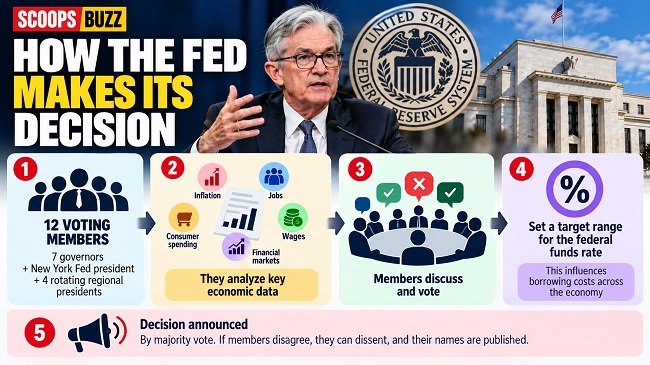
The Federal Open Market Committee has 12 voting members. They are the seven members of the Fed’s Board of Governors in Washington, the president of the Federal Reserve Bank of New York, and four of the other 11 regional Fed bank presidents, who take turns voting each year.
The committee looks at a wide range of data, including inflation, jobs, wages, consumer spending and financial markets. It then votes on a target range for the federal funds rate, the rate banks charge each other for overnight loans. That rate influences borrowing costs across the whole economy.
Decisions are made by majority vote. Members who disagree can dissent, and their names are published with the statement.
Kevin Warsh’s First Year as Fed Chair
Kevin Warsh became chair of the Federal Reserve in May 2026. A former Fed governor, he has changed some of the ways the central bank communicates.
Notably, Warsh has moved away from “forward guidance,” the practice of signaling future moves in advance. Supporters say this gives the Fed more flexibility. Critics say it leaves markets with less certainty, which can make reactions to each decision bigger.
Warsh may also discuss changes to how the Fed operates, as internal task forces report back. Those changes could shape policy in 2027 and beyond.
What to Watch at the Fed Meeting October 2026
Fed Meeting: 4 Things to Watch
Beyond the headline decision, investors will be looking at:
- The statement wording. Any hint about December could move markets.
- Dissents. If rates are held, watch whether some officials vote for a hike, as three did in July.
- The press conference. Warsh’s comments on inflation, energy prices and the job market will be closely studied.
- Market reaction. Stocks, bond yields and the US dollar can move sharply in the minutes after 2 p.m. ET.
What the Fed Meeting October 2026 Means for You
How the Fed Meeting Affects Your Money
Rate hikes can increase borrowing costs.
Market expectations influence home loan rates.
New auto loans may become more expensive.
Higher rates may improve savings returns.
Higher rates can put pressure on share prices.
Variable rates may rise when Fed rates increase.
The federal funds rate affects many of the interest rates people pay and earn.
Credit cards. Card interest rates usually move with the Fed. If the Fed raises rates again, expect card rates to rise within a billing cycle or two. Paying down high-interest balances now is one of the best moves you can make.
Mortgages. Fixed mortgage rates follow long-term bond yields more than the Fed’s rate directly, but they often rise when markets expect more hikes. If you are buying a home, consider locking in a rate once you find one you can afford.
Home equity lines and adjustable loans. These are often tied directly to short-term rates, so they are likely to get more expensive if the Fed hikes.
Car loans. New auto loan rates tend to rise along with Fed hikes, adding to monthly payments.
Savings accounts and CDs. This is the good news. High-yield savings accounts and certificates of deposit usually pay more when rates rise. If your money is sitting in an account paying almost nothing, it may be worth shopping around.
Stocks. Higher rates can weigh on stock prices, especially fast-growing tech companies, because they make borrowing more expensive and bonds more attractive.
Simple Steps to Prepare Your Finances
4 Smart Steps to Protect Your Money
Whatever the Fed decides this week, a few steps can protect your budget if rates keep rising:
- Pay down variable-rate debt first. Credit cards and home equity lines get more expensive fastest.
- Lock in fixed rates where it makes sense. If you need a mortgage or car loan soon, a fixed rate removes the risk of further hikes.
- Move idle cash. Compare high-yield savings accounts and short-term CDs, which tend to pay more when rates rise.
- Keep an emergency fund. With job growth slowing, a cushion of several months of expenses matters more than usual.
Fed Terms Explained
Fed Terms, Made Simple
0.01 percentage point; 25 basis points = 0.25 percentage points.
Favors higher rates to fight inflation.
Favors lower rates to support jobs and growth.
The Fed committee that sets interest-rate policy.
A chart of Fed officials’ rate projections, published quarterly.
- Basis point: One hundredth of a percentage point. A 25 basis point hike equals 0.25 percentage points.
- Hawkish: Favoring higher rates to fight inflation.
- Dovish: Favoring lower rates to support jobs and growth.
- FOMC: The Federal Open Market Committee, the Fed group that sets interest rates.
- Dot plot: A chart showing where each Fed official expects rates to go, published four times a year.
What It Means for UK and European Readers
The Fed sets US rates, but its decisions ripple worldwide. A higher US rate tends to strengthen the dollar, which affects exchange rates for travelers and businesses, and can influence global stock markets. The Bank of England and the European Central Bank make their own decisions, but they also face higher energy prices driven by the same Middle East supply problems.
Fed Meeting October 2026: Key Numbers
| Measure | Latest |
| Federal funds rate | 3.75% to 4% |
| Inflation (CPI, September) | 3.7% a year |
| Core inflation (September) | 2.6% a year |
| Jobs added (September) | 29,000 |
| Unemployment rate | 4.2% |
| Market odds of an October hold | About 80% |
| Next meeting after this one | December 9 |
More From ScoopsBuzz
- Meta Q3 2026 earnings: revenue jumps 26% as AI spending soars
- How to lower heating bills this winter: 15 tips that work
Frequently Asked Questions
When is the Fed meeting October 2026?
The Fed meets October 27 and 28, 2026, with the decision expected at 2 p.m. ET on Wednesday, October 28.
Will the Fed raise interest rates in October 2026?
Markets expect a hold, with about an 80% chance of no change, but a rate hike is still possible. A hike is more widely expected in December.
What is the current federal funds rate?
The target range is 3.75% to 4% after a quarter point hike in September 2026.
Why is the Fed raising rates in 2026?
Inflation has climbed again, reaching 3.7% in September, largely because of higher energy prices.
Who is the Fed chair?
Kevin Warsh has been chair of the Federal Reserve since May 2026.
How will a Fed rate hike affect me?
It would likely raise rates on credit cards, home equity lines and car loans, while increasing what savers earn on high-yield accounts and CDs.
When is the next Fed meeting after October?
The final Fed meeting of 2026 ends on December 9.
Disclaimer: This article is for general information only and is not financial advice.
Sources: J.P. Morgan Wealth Management via Chase, Forbes, CME FedWatch, Bureau of Labor Statistics, Federal Reserve


3 Comments