

Table of Contents
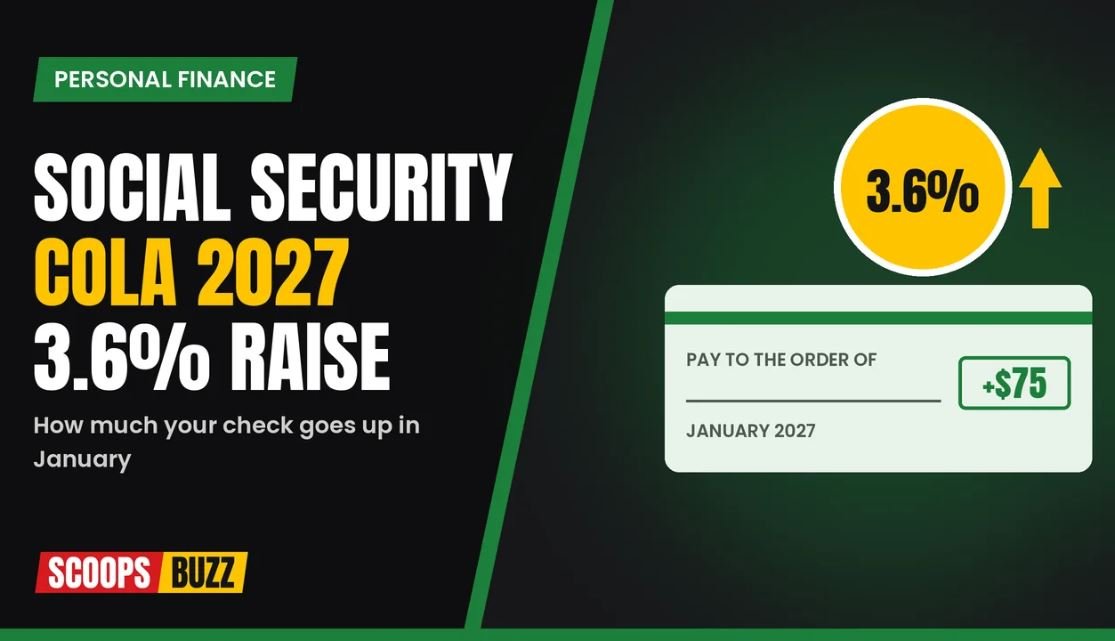
The Social Security COLA 2027 is 3.6%, the largest raise since 2023. The average retired worker will get about $75 more a month, rising to roughly $2,170. The new amounts start with payments for January 2027. The SSI federal payment rises to $1,029 a month for one person and $1,544 for a couple. Medicare Part B costs are projected to rise to about $209.50 a month, which will take a bite out of the raise.
Tens of millions of retired and disabled Americans will see bigger checks in the new year. The Social Security Administration has confirmed that benefits will rise 3.6% in 2027, the biggest increase in three years.
The Social Security COLA 2027 was announced on October 14, after the latest inflation numbers showed prices climbing faster again, led by gasoline and energy. The raise will reach about 76 million people who get Social Security or Supplemental Security Income.
Here is what the Social Security COLA 2027 means for you, how much your check will grow, when the money arrives and what could take some of it away.
What Is the Social Security COLA 2027?

COLA stands for cost of living adjustment. It is the yearly raise Social Security gives to keep benefits in line with rising prices.
For 2027, the cost of living adjustment, or Social Security COLA 2027, is 3.6%. That is up from 2.8% in 2026 and 2.5% in 2025. It is the largest increase since 2023, when benefits jumped 8.7% after a burst of high inflation.
Social Security Commissioner Frank Bisignano said the adjustment will provide “greater financial stability” for people who rely on their monthly payments.
The raise applies to retirement benefits, survivor benefits, disability benefits and SSI. You do not need to apply for it. It is added automatically.
How Much Will Your Check Go Up Under the Social Security COLA 2027?
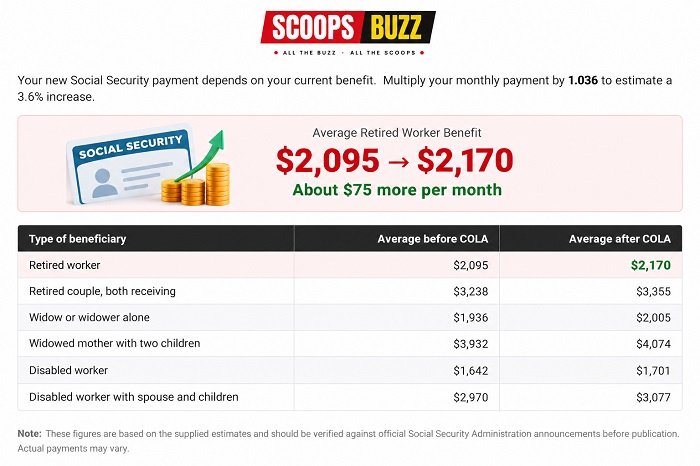
The exact amount you get from the Social Security COLA 2027 depends on your current benefit. To estimate your new check, multiply your current monthly payment by 1.036.
According to the Social Security Administration, the average retired worker will get about $75 more a month, with the average check rising from about $2,095 to $2,170.
| Type of beneficiary | Average before COLA | Average after COLA |
| Retired worker | $2,095 | $2,170 |
| Retired couple, both receiving | $3,238 | $3,355 |
| Widow or widower alone | $1,936 | $2,005 |
| Widowed mother with two children | $3,932 | $4,074 |
| Disabled worker | $1,642 | $1,701 |
| Disabled worker with spouse and children | $2,970 | $3,077 |
Over a full year, that works out to about $900 extra for the average retiree, according to the Committee for a Responsible Federal Budget.
The highest possible benefit for someone retiring at full retirement age rises to $4,188 a month in 2027, up from $4,152.
Why the Social Security Raise Is Bigger This Year
The COLA is tied to an inflation measure called the CPI-W, the Consumer Price Index for Urban Wage Earners and Clerical Workers.
Each year, Social Security compares the average CPI-W for July, August and September with the same three months a year earlier. The difference becomes the next year’s raise.
Inflation picked up through the summer. In September, the CPI-W was 3.9% higher than a year earlier. The broader Consumer Price Index rose 3.7%, with gasoline prices up 9.1% in a single month as the conflict in the Middle East pushed up oil prices.
That jump in energy costs is the main reason the Social Security increase 2027 is larger than last year’s.
Is the Social Security COLA 2027 Enough?
For many older Americans, the Social Security COLA 2027 still falls short.
The Senior Citizens League, an advocacy group for retirees, has long argued that the COLA formula does not reflect what seniors actually spend money on, such as housing, medicine and health care.
“Prices go up today, but benefits stay the same for months due to an outdated COLA methodology,” said Shannon Benton, the group’s executive director.
Mary Johnson, an independent Social Security policy analyst, put it more simply when talking about the average increase. “That may get us one fill-up at the gas station,” she said.
The timing also hurts. Prices began rising months ago, but the raise does not show up until January. Many retirees will spend the rest of 2026 paying higher costs with their old benefit amount.
When Will the Social Security COLA 2027 Show Up?
The January 2027 SSI payment is scheduled early because January 1 is a federal holiday. Eligible recipients generally receive the payment on the preceding business day.
The Social Security COLA 2027 starts with benefits for January 2027. Most people will see the larger check in January.
SSI recipients will see it a little earlier. Because January 1 is a federal holiday, the SSI payment for January 2027 is expected to arrive on Thursday, December 31, 2026.
Most Social Security payments follow a schedule based on your birth date:
| Birth date | January 2027 payment date |
| 1st to 10th of the month | Wednesday, January 13 |
| 11th to 20th of the month | Wednesday, January 20 |
| 21st to 31st of the month | Wednesday, January 27 |
People who started benefits before May 1997, or who get both Social Security and SSI, are usually paid early in the month. Check your own schedule on your account to be sure.
How to See Your New Benefit Amount
Social Security will send COLA notices in early December. This year the notice is one page and shows your new benefit amount and payment date.
If you have a personal my Social Security account, you can see your notice online in the Message Center before the paper letter arrives. People on Medicare can usually view their new amount there in late November.
You can find full details of the new figures on the Social Security Administration’s COLA page.
SSI Payment 2027
| Recipient | 2026 | 2027 |
|---|---|---|
| Individual | $994 | $1,029 |
| Couple | $1,491 | $1,544 |
Supplemental Security Income helps people with very low income who are 65 or older, blind or disabled. SSI also gets the Social Security COLA 2027 raise of 3.6%.
| SSI federal payment | 2026 | 2027 |
| Individual | $994 a month | $1,029 a month |
| Couple | $1,491 a month | $1,544 a month |
Some states add their own payment on top of the federal amount, so your total may be higher.
Medicare Part B Premium 2027 Will Take a Bite
$202.90 in 2026 → projected $209.50 in 2027
About $68 of a $75 monthly COLA increase may remain.
This rule protects many beneficiaries from a Part B increase reducing their Social Security payment.
For most retirees, Medicare Part B premiums come straight out of their Social Security check. That means any increase in Part B shrinks the part of the Social Security COLA 2027 you actually see.
In 2026, the standard Part B premium is $202.90 a month. Medicare’s trustees have projected it will rise to about $209.50 a month in 2027, an increase of $6.60. The yearly Part B deductible is projected to rise from $283 to about $292.
The official 2027 numbers are expected from the Centers for Medicare and Medicaid Services later this fall.
If the projection holds, the average retiree would keep about $68 of the $75 raise after the higher premium.
There is some protection. A rule known as the hold harmless provision stops a Part B increase from lowering most people’s Social Security check below what they got the year before. But about 30% of people on Medicare are not covered by it, including higher earners who pay extra and people who do not get Social Security checks.
Medicare Open Enrollment Is Happening Now
Medicare open enrollment runs from October 15 to December 7 every year. This is your chance to change Medicare Advantage or Part D drug plans for 2027.
With Part B and many drug plan costs going up, it is worth checking that your current plan still fits your needs and budget. Plans can change their premiums, deductibles and covered drugs each year.
You can compare plans side by side using the Medicare Plan Finder. Any change you make takes effect on January 1.
Social Security Earnings Test Limit for 2027
If you take Social Security before your full retirement age and keep working, part of your benefit may be held back if you earn too much. These limits also rise for 2027.
| Earnings test | 2026 | 2027 |
| Under full retirement age | $24,480 a year | $25,560 a year |
| Year you reach full retirement age | $65,160 a year | $67,920 a year |
If you are under full retirement age all year, Social Security holds back $1 for every $2 you earn above the limit. In the year you reach full retirement age, it holds back $1 for every $3 above the higher limit, counting only earnings before the month you reach that age.
Once you reach full retirement age, there is no limit, and the benefits that were held back are added back into your monthly payment over time.
Taxable Maximum Rises for Workers
The Social Security COLA 2027 is not the only change. Workers will also pay Social Security tax on more of their income.
The taxable maximum rises to $192,300 in 2027, up from $184,500. Earnings above that amount are not subject to the 6.2% Social Security payroll tax.
The amount you need to earn for one work credit also rises, to $1,970, up from $1,890. Most people need 40 credits, or about 10 years of work, to qualify for retirement benefits.
Will Your Social Security Raise Be Taxed?
It might be. Up to 85% of Social Security benefits can be subject to federal income tax, depending on your total income.
The income limits that decide whether benefits are taxed have not changed since the 1980s and 1990s. As benefits rise each year, more retirees cross those limits. A bigger raise like the Social Security COLA 2027 can push some people into owing tax on their benefits for the first time.
A number of states also tax Social Security benefits, though most do not.
What the Raise Means for Your Budget
Use your confirmed benefit amount to plan your 2027 budget.
Compare coverage and prescription drug plans during open enrollment.
Check eligibility for Medicare Savings Programs and Extra Help.
Budget for heating and other seasonal energy costs.
Compare savings accounts and CDs, including their rates and terms.
Even a modest raise like the Social Security COLA 2027 can help if you plan ahead. A few simple steps can stretch the extra money:
- Check your new amount in December. Use the real number from your notice, not an estimate, when you plan your 2027 budget.
- Review your Medicare plan. Open enrollment ends December 7. A cheaper drug plan could save more than the raise itself.
- Look for help with bills. Programs like Medicare Savings Programs and Extra Help can cut health costs for people with limited income.
- Plan for heating costs. Energy prices are a big reason for the raise, and winter bills could be higher this year.
- Watch interest rates. Savings accounts and CDs are paying more as the Federal Reserve keeps rates high, which can help retirees with cash in the bank.
The Long-Term Worry: Social Security Trust Fund
The Social Security COLA 2027 comes as the program faces a long-term money problem.
The program’s trustees estimate that the main trust fund for retirement and survivor benefits could run short in about 2032. If Congress does nothing by then, Social Security would only be able to pay about 78% of scheduled benefits, which would mean an across-the-board cut of about 22%.
Lawmakers from both parties have proposed fixes, including raising the taxable maximum, changing the retirement age or adjusting how benefits grow. So far, no plan has passed.
For people getting benefits today, nothing changes now. But the issue is likely to come up more often as 2032 gets closer.
A Look Back at Recent COLAs
| Year | COLA |
| 2023 | 8.7% |
| 2024 | 3.2% |
| 2025 | 2.5% |
| 2026 | 2.8% |
| 2027 | 3.6% |
Over the past 10 years, the average COLA has been about 2.6%, so the Social Security COLA 2027 is above normal.
More From ScoopsBuzz
- Fed meeting October 2026: will the Fed raise interest rates?
- How to lower heating bills this winter: 15 tips that work
Frequently Asked Questions
What is the Social Security COLA 2027?
The cost of living adjustment for 2027 is 3.6%. It applies to Social Security and SSI benefits starting in January 2027.
How much will my Social Security check go up?
Multiply your current benefit by 1.036. The average retired worker will get about $75 more a month, bringing the average check to about $2,170.
When will I get the Social Security raise?
The raise starts with January 2027 payments. SSI recipients should get their January payment on December 31, 2026.
What is the SSI payment for 2027?
The federal SSI payment rises to $1,029 a month for an individual and $1,544 for a couple.
How much will Medicare Part B cost in 2027?
The standard premium is projected at about $209.50 a month, up from $202.90. The official number is expected later this fall.
What is the Social Security earnings limit for 2027?
It is $25,560 a year if you are under full retirement age, and $67,920 in the year you reach full retirement age.
Do I need to apply for the COLA?
No. The increase is added to your benefit automatically.
Disclaimer: This article is for general information only and is not financial or tax advice.
Sources: Social Security Administration, Fox Business, Plan Sponsor Council of America, The Senior Citizens League, AARP




1 Comment