


Table of Contents
The 2026 midterm elections are on Tuesday, November 3, 2026. All 435 House seats, 35 Senate seats and 36 governorships are on the ballot. Republicans hold the Senate 53 to 47, so Democrats need a net gain of four seats to take control. Close Senate races include Maine, North Carolina, Ohio, Texas, Iowa, Alaska, Michigan and Georgia. Forecasts differ, and several key races are rated toss-ups less than two weeks before Election Day. Voting rules and deadlines vary by state, so check your state’s rules at Vote.gov.
The 2026 midterm elections are less than two weeks away. On Tuesday, November 3, Americans will choose every member of the House of Representatives, a third of the Senate and governors in 36 states.
The results will decide which party controls Congress for the final two years of President Donald Trump’s second term. That means they will shape what laws can pass, which nominees are confirmed and how much oversight the White House faces.
Here is a simple guide to the 2026 midterm elections, including what is on the ballot, the Senate races that could decide control, what the forecasts say and how to vote.
When Are the Midterms in 2026?
Election Day: Tuesday, November 3, 2026
Election Day is Tuesday, November 3, 2026. Polls open and close at different times in each state, so check your local hours.
Many states also offer early voting and mail ballots, and some of those options have already started. In a close election, final results in some races may take days to count, especially in states that accept mail ballots arriving after Election Day.
Midterms happen halfway through a president’s four-year term, which is where the name comes from.
What Is on the Ballot in the 2026 Midterm Elections
| Office | Seats up in 2026 |
| US House of Representatives | All 435 seats |
| US Senate | 35 of 100 seats (33 regular, 2 special elections) |
| Governors | 36 states, plus 3 US territories |
The two Senate special elections are in Ohio and Florida. They fill the seats left empty when JD Vance became vice president and Marco Rubio became secretary of state. Both seats are currently held by Republicans appointed to fill them, Jon Husted in Ohio and Ashley Moody in Florida.
Thousands of state and local races are on the ballot too, from state legislatures to judges and ballot measures.
Who Controls Congress Now

Republicans won control of the Senate in 2024 and currently hold a 53 to 47 majority. Democrats would need a net gain of four seats to reach 51 and take control, since Vice President JD Vance would break any 50 to 50 tie in Republicans’ favor.
Republicans also hold a narrow majority in the House. With such a small margin, a shift of just a few seats could hand control to Democrats.
Historically, the president’s party usually loses seats in midterm elections. Supporters of the current majority point out that the Senate map still includes many states Trump won in 2024, which gives Republicans some advantages.
How Midterms Usually Go
Historical trends are not guaranteed predictions.
History favors the party out of power in midterm years. In most midterms since World War II, the president’s party has lost seats in the House.
| Midterm year | President’s party | House result |
| 2010 | Democrats (Obama) | Lost 63 seats and the majority |
| 2018 | Republicans (Trump) | Lost 40 seats and the majority |
| 2022 | Democrats (Biden) | Lost 9 seats and the majority, but gained a Senate seat |
The 2022 result shows the pattern is not guaranteed. Strong candidates, local issues and turnout can all push results away from history, especially in the Senate, where only a third of seats are on the ballot.
Senate Races to Watch in the 2026 Midterm Elections
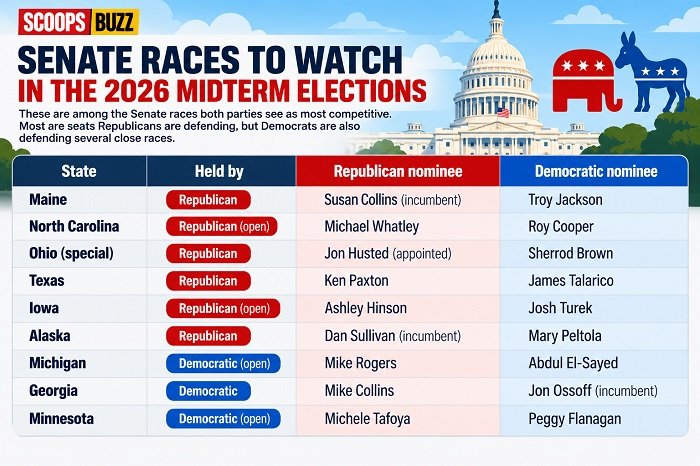
These are among the Senate races both parties see as most competitive. Most are seats Republicans are defending, but Democrats are also defending several close races.
| State | Held by | Republican nominee | Democratic nominee |
| Maine | Republican | Susan Collins (incumbent) | Troy Jackson |
| North Carolina | Republican (open) | Michael Whatley | Roy Cooper |
| Ohio (special) | Republican | Jon Husted (appointed) | Sherrod Brown |
| Texas | Republican | Ken Paxton | James Talarico |
| Iowa | Republican (open) | Ashley Hinson | Josh Turek |
| Alaska | Republican | Dan Sullivan (incumbent) | Mary Peltola |
| Michigan | Democratic (open) | Mike Rogers | Abdul El-Sayed |
| Georgia | Democratic | Mike Collins | Jon Ossoff (incumbent) |
| Minnesota | Democratic (open) | Michele Tafoya | Peggy Flanagan |
Maine
Susan Collins is the only Republican senator on the ballot this year in a state Kamala Harris won in 2024. She has survived tough races before. Her Democratic opponent, Troy Jackson, became the nominee through a state party convention.
North Carolina
Republican Senator Thom Tillis is retiring. Former Democratic Governor Roy Cooper, who has never lost a statewide race, faces Michael Whatley, who has led the Republican National Committee and is endorsed by Trump.
Ohio
Former Democratic Senator Sherrod Brown is trying to return to the Senate against Jon Husted, who was appointed to the seat in 2025. Ohio has voted strongly Republican in recent elections, and Brown lost his previous race in 2024.
Texas
Attorney General Ken Paxton defeated longtime Senator John Cornyn in the Republican runoff. He faces Democratic state lawmaker James Talarico. Texas has not elected a Democrat to the Senate since 1988, but Democrats hope the open contest gives them a chance.
Iowa and Alaska
In Iowa, Senator Joni Ernst is retiring, and Republican Representative Ashley Hinson faces Democrat Josh Turek. In Alaska, Senator Dan Sullivan faces former Representative Mary Peltola, in a state that uses ranked choice voting in general elections.
Michigan and Georgia
These are Republicans’ best chances to gain seats. In Michigan, former Representative Mike Rogers, who narrowly lost the state’s 2024 Senate race, faces Democrat Abdul El-Sayed for an open seat. In Georgia, Democratic Senator Jon Ossoff faces Representative Mike Collins in a state Trump carried in 2024.
Also worth watching
In Minnesota and New Hampshire, Democrats are defending open seats after their senators retired. In Nebraska, independent Dan Osborn is again challenging a Republican incumbent, Senator Pete Ricketts, with the backing of the state Democratic Party.
Battleground States for Senate Control
Senate control in 2026 is likely to come down to a handful of battleground states. Democrats need to hold their own close seats in Michigan, Georgia, Minnesota and New Hampshire while flipping at least four Republican seats from a list that includes Maine, North Carolina, Ohio, Texas, Iowa and Alaska.
Republicans can keep the majority by holding most of their seats, and they would add a cushion by winning Michigan or Georgia. Because so many races are close, a strong night for either party could produce a bigger swing than the forecasts suggest.
What the Forecasts Say
Decision Desk HQ forecast • October 23, 2026
Key toss-up races: Iowa, Maine, Ohio and Texas.
Forecasters do not agree on a clear favorite, and several of the races above are rated as toss-ups.
As of October 23, the election forecaster Decision Desk HQ gave Democrats a 57% chance of winning the Senate and Republicans a 43% chance. Its toss-up races included Iowa, Maine, Ohio and Texas.
Other forecasters and betting markets show different numbers, and polls in close races are often within the margin of error. A 57% chance is far from certain. In simple terms, either party could control the Senate after November 3.
Why Redistricting Matters This Year
Several states drew new congressional maps in the middle of the decade, which is unusual. Texas, Missouri and North Carolina redrew their maps, California changed its map after voters approved Proposition 50, and courts ordered new districts in Ohio and Utah.
Supporters of each new map say it is fair and legal. Critics in both parties say some maps were drawn for partisan advantage. Because the House majority is so narrow, these changes could decide which party controls the chamber.
The Issues Voters Care About
The Issues Voters Care About
Voters’ views on these issues and the competing arguments over congressional control could shape the November 2026 midterm results.
Polls suggest many voters heading into the 2026 midterm elections are focused on the cost of living, including grocery prices, housing and energy bills. Other major issues include the economy and jobs, immigration, health care costs, and the performance of the Trump administration.
Republicans are asking voters to keep Congress in their hands so the president’s agenda can continue. Democrats are asking voters to give them control as a check on the White House. How undecided voters weigh those arguments will shape the result.
Governor Races in 2026
Thirty-six states will elect a governor in the 2026 midterm elections. Governors control state budgets and can sign or veto laws on taxes, schools, abortion rules and elections. Many of the most-watched races are in swing states, where the next governor will also oversee how the 2028 presidential election is run.
What Could Happen After the Election
What Could Happen After the Election?
Republicans would retain control of the legislative agenda and Senate confirmations.
Each party would control one chamber, making bipartisan support important for major bills.
Democrats would control the congressional agenda and lead investigations, while presidential veto power would remain.
There are three broad outcomes for Congress:
- Republicans keep both chambers. The president’s party would continue to control the legislative agenda, and Senate confirmations of judges and officials would move ahead.
- Control is split. If each party wins one chamber, most major bills would need support from both sides to pass. The Senate would still control confirmations.
- Democrats win both chambers. Democrats would control which bills come up for a vote and lead congressional investigations, while the president would keep the power to veto bills.
Divided government has been common in modern US history, and each party argues it leads to different results. Supporters of divided government say it forces compromise, while critics say it leads to gridlock.
Key Dates to Know
| Date | What happens |
| Now to November 2 | Early voting and mail voting in many states |
| November 3, 2026 | Election Day |
| November and December | Counting, certification and any recounts or runoffs |
| January 3, 2027 | New Congress is sworn in |
How to Vote in the 2026 Midterms
🗳️ How to Vote in 2026
Voting rules are set by each state, so the details depend on where you live.
- Check your registration. Many states have registration deadlines before Election Day, though some allow same day registration.
- Find your polling place. Polling locations can change, so confirm yours before you go.
- Look at early voting. Most states offer some form of early in-person voting.
- Return mail ballots on time. Check your state’s deadline for mailing or dropping off a ballot.
- Bring the right ID. Some states require photo ID at the polls.
The official US government site Vote.gov links to registration and voting information for every state. You can find more background on all the races at the 2026 United States elections page.
What Happens After November 3
The new Congress will be sworn in on January 3, 2027. If control of either chamber changes, the new majority will choose the leaders and committee chairs who decide which bills get votes.
Some close races in the 2026 midterm elections may not be called on election night. Recounts and runoffs are also possible in very tight contests. We will update this guide as results come in.
More From ScoopsBuzz
- Meta Q3 2026 earnings: revenue jumps 26% as AI spending soars
- Flu season 2026: who should get the flu shot in the US and UK
Frequently Asked Questions
When are the 2026 midterm elections?
The 2026 midterm elections are on Tuesday, November 3, 2026.
What is on the ballot in the 2026 midterms?
All 435 House seats, 35 Senate seats including two special elections, and 36 governorships, plus many state and local races.
Who controls the Senate now?
Republicans hold a 53 to 47 majority. Democrats need a net gain of four seats to win control.
Which Senate races are the closest?
Races in Maine, North Carolina, Ohio, Texas, Iowa, Alaska, Michigan and Georgia are among the most competitive.
When will we know the results?
Many races will be called on election night, but close contests may take several days to count, especially where mail ballots are still arriving.
How do I vote in the 2026 midterm elections?
Check your registration and your state’s deadlines at Vote.gov, find your polling place, and look into early voting or mail voting options in your state.
Sources: Decision Desk HQ, Wikipedia (2026 United States elections and 2026 Senate elections), Fox News, Britannica, Vote.gov
Also Read- World Series 2026: Brewers vs Rays Schedule, How to Watch and Game 1 Recap