

Table of Contents
The best time to see the northern lights is from late September to late March, when nights are long and dark. Top places include Tromsø in Norway, Finnish and Swedish Lapland, Iceland, Fairbanks in Alaska and Yellowknife in Canada. In the UK, the north of Scotland, including Shetland, Orkney and Caithness, gives the best chance. Clear skies, darkness away from city lights and strong solar activity are all needed. The sun is still very active after its recent peak, so strong displays remain possible this winter.
Few sights on Earth are as magical as the northern lights. Ribbons of green, pink and purple light dance across the night sky, sometimes moving so fast it looks as if the sky is alive.
Seeing the aurora borealis is on the bucket list of millions of travelers. In the past two years, strong solar storms even brought the lights far south, with people seeing them across the UK, much of Europe and even parts of the southern United States.
Here is where to see the northern lights, the best months and times to go, and how to give yourself the best chance of catching them this winter.
What Are the Northern Lights?
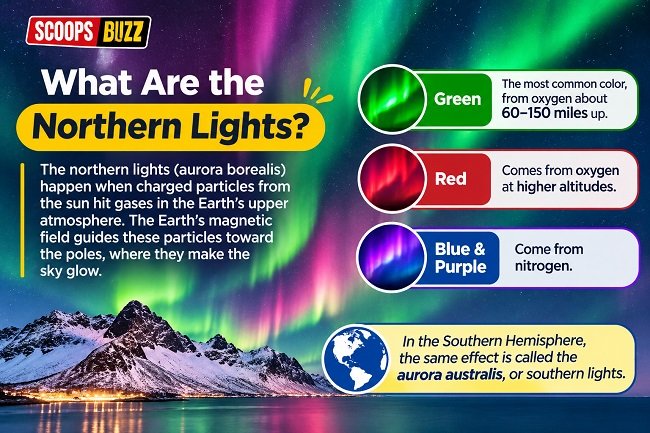
The northern lights, or aurora borealis, happen when charged particles from the sun hit gases in the Earth’s upper atmosphere. The Earth’s magnetic field guides these particles toward the poles, where they make the sky glow.
- Green, the most common color, comes from oxygen about 60 to 150 miles up.
- Red comes from oxygen at higher altitudes.
- Blue and purple come from nitrogen.
In the Southern Hemisphere, the same effect is called the aurora australis, or southern lights.
When Is the Best Time to See the Northern Lights?
Best Time to See the Northern Lights
Plan your aurora adventure with the right season, viewing hours and weather conditions.
September to March
The ideal viewing season when nights are long and skies are dark.
10 PM – 2 AM
A popular time window for spotting beautiful aurora displays.
Clear, Dark Skies
Cloud-free skies are essential for seeing the northern lights.
Choose a dark location away from city lights and check aurora activity before heading out.
Best months: Late September to late March. The lights happen all year, but you need dark skies to see them. In summer, the far north has almost no darkness.
Many experts say September, October, February and March can be especially good, as activity often rises around the spring and autumn equinoxes.
Best time of night: Usually between 10 p.m. and 2 a.m., though displays can happen any time it is dark.
Weather: Clear skies are essential. Even a strong aurora will be hidden by thick cloud.
Is This a Good Year to See the Northern Lights?
Yes. The sun goes through an 11 year cycle of activity. Scientists said it reached the peak of its current cycle, known as solar maximum, around late 2024.
Activity is now slowly declining, but the years just after the peak often bring some of the strongest solar storms. That means the 2026 to 2027 winter is still a very good time to plan a trip.
You can check space weather alerts and aurora forecasts from the US government’s NOAA Space Weather Prediction Center.
Where to See the Northern Lights: Best Places in Europe
6 Best Places to See Northern Lights in Europe
Explore Europe’s top aurora destinations, from Norway’s Arctic coast to the remote landscapes of Greenland.
| Destination | Best Places to Visit | Why Visit? |
|---|---|---|
| 🇳🇴 Tromsø, Norway Popular Choice | Arctic Circle, Tromsø city and surrounding countryside | Excellent aurora tours, easy flights and lively city life. |
| 🇳🇴 Lofoten Islands & North Cape Scenic Views | Lofoten Islands and North Cape | Dramatic mountains, beaches and dark Arctic skies. |
| 🇸🇪 Abisko, Sweden Clear Skies | Abisko National Park and Aurora Sky Station | Famous for its local clear-sky conditions and aurora viewing. |
| 🇫🇮 Finnish Lapland Family Friendly | Rovaniemi, Saariselkä, Inari and Levi | Glass-roofed cabins, igloos and magical winter experiences. |
| 🇮🇸 Iceland Easy Access | Reykjavík and Þingvellir National Park | Accessible tours, beautiful landscapes and dark countryside skies. |
| 🇫🇴 Faroe Islands & Greenland Remote Escape | Faroe Islands and Greenland | Remote wilderness, spectacular scenery and dark skies. |
Choose a location away from city lights, check cloud forecasts and stay for several nights to improve your chances of seeing the aurora.
Europe has some of the most accessible aurora destinations in the world, many just a short flight from the UK.
Tromsø, Norway
Often called the “capital of the northern lights,” Tromsø sits about 200 miles north of the Arctic Circle, right under the band where auroras are most common. It has a lively city center, good flights from across Europe and many tours that chase clear skies.
Norwegian Lofoten Islands and North Cape
The dramatic mountains and beaches of the Lofoten Islands make for stunning photos. Farther north, the North Cape area offers dark, remote skies.
Abisko, Sweden
Abisko National Park in Swedish Lapland is famous for its clear skies, thanks to a local weather pattern often called the “blue hole.” The Aurora Sky Station is a popular viewing spot.
Finnish Lapland
Rovaniemi, home of the famous Santa Claus Village, is a family favorite. Farther north, places such as Saariselkä, Inari and Levi offer glass roofed cabins and igloos where you can watch the lights from bed.
Iceland
Iceland is one of the easiest places to see the northern lights from the US or UK, with short flights and plenty of tours. You can sometimes see them near Reykjavík, but driving out into the countryside to places like Þingvellir National Park gives you darker skies.
Faroe Islands and Greenland
For something more remote, the Faroe Islands and Greenland offer wild landscapes and very dark skies, though weather can be unpredictable.
Where to See the Northern Lights in the UK
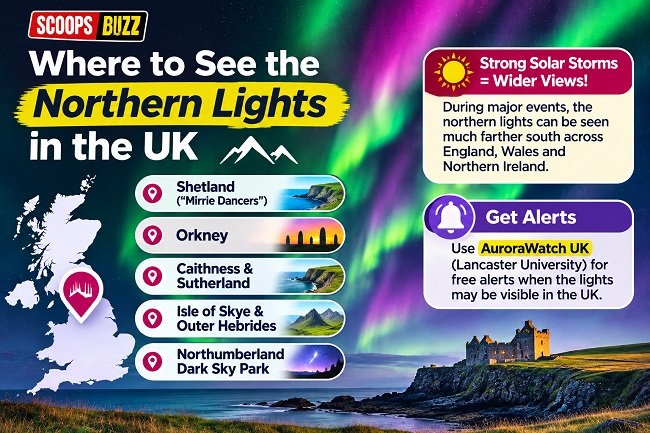
If you are wondering where to see the northern lights without a long trip, you do not always have to leave Britain. The best places to see the northern lights in the UK are in the far north:
- Shetland, where the lights are known locally as the “Mirrie Dancers”
- Orkney
- Caithness and Sutherland in the Scottish Highlands
- The Isle of Skye and the Outer Hebrides
- Northumberland Dark Sky Park in northern England, during strong displays
During very strong solar storms, the lights can be seen much farther south. In May 2024 and October 2024, people across England, Wales and Northern Ireland saw bright auroras.
In the UK, Lancaster University’s AuroraWatch UK service sends free alerts when the lights may be visible.
Where to See the Northern Lights in North America
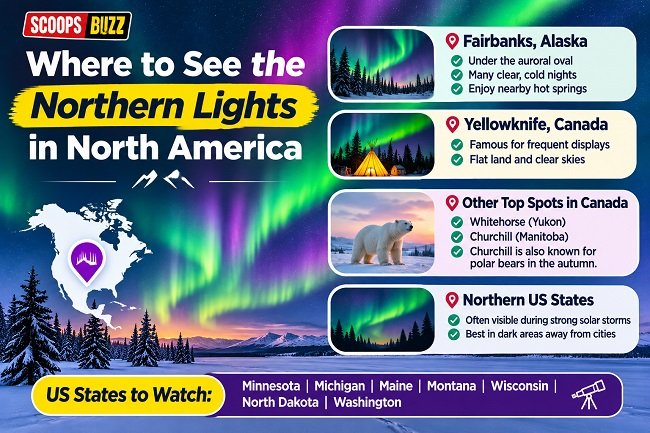
For American travelers, the answer to where to see the northern lights may be closer than you think.
Fairbanks, Alaska
Fairbanks sits under the auroral oval and is one of the best places in the world to see the lights, with many clear, cold nights. Nearby hot springs make for a memorable night out.
Yellowknife, Canada
Yellowknife in the Northwest Territories is famous for its flat land and clear skies, with very frequent displays during the season.
Other Spots in Canada
Whitehorse in Yukon and Churchill in Manitoba are also excellent. Churchill is known for polar bears in the autumn as well.
Northern US States
During strong solar storms, the lights can be seen in states such as Minnesota, Michigan, Maine, Montana, Wisconsin, North Dakota and Washington. Dark spots away from cities give the best chance.
Best Places Compared
Here is a quick summary of where to see the northern lights, depending on what kind of trip you want.
| Place | Country | Best for |
| Tromsø | Norway | City base with many tours |
| Abisko | Sweden | Clear skies |
| Rovaniemi and Lapland | Finland | Families and glass igloos |
| Reykjavík and countryside | Iceland | Short flights from US and UK |
| Shetland and Orkney | UK | No passport needed for UK travelers |
| Fairbanks | US | Frequent displays in the US |
| Yellowknife | Canada | Very clear skies |
How to Improve Your Chances
7 Tips to See the Northern Lights
Improve your chances of witnessing the magical aurora with these simple viewing tips.
Stay for 3–4 Nights
Aurora displays are unpredictable. Staying longer gives you more opportunities to see them.
Escape City Lights
Choose dark locations away from towns and artificial lights for clearer views.
Check the Aurora Forecast
Monitor aurora forecasts and the Kp index. Higher Kp values can mean visibility farther south.
Watch the Weather
Check cloud forecasts and be prepared to travel to an area with clearer skies.
Be Patient
Auroras can appear and disappear quickly. Allow at least an hour for viewing.
Join a Guided Tour
Local guides can help you find suitable viewing locations and clearer skies.
Look Towards the North
In the Northern Hemisphere, auroras often appear near the northern horizon first.
Knowing where to see the northern lights is only half the story. These tips help on the night.
- Stay at least three or four nights. The lights are never guaranteed, so more nights mean more chances.
- Get away from city lights. Light pollution washes out fainter displays.
- Check the aurora forecast and the Kp index, which measures geomagnetic activity on a scale from 0 to 9. Higher numbers mean the lights may be seen farther south.
- Check cloud forecasts and be ready to move to clearer skies.
- Be patient. Displays can come and go. Wait outside for at least an hour.
- Join a tour. Local guides know where the skies are clearest and can drive you there.
- Look north. In the Northern Hemisphere, the lights usually appear toward the northern horizon first.
Northern Lights Holidays: What to Plan
6 Fun Activities for Your Northern Lights Holiday
Make your Arctic adventure unforgettable with exciting winter experiences beyond the northern lights.
Husky Sledding & Reindeer Safaris
Explore snowy landscapes with husky teams and traditional reindeer rides in Lapland and Norway.
Snowmobile Tours
Ride across frozen lakes and snowy forests for an exciting Arctic adventure.
Whale Watching
Enjoy winter whale-watching trips around Tromsø and discover Arctic marine life.
Hot Springs & Geothermal Lagoons
Relax in naturally warm waters surrounded by beautiful winter scenery in Iceland and Alaska.
Stay in an Ice Hotel
Experience unique ice-built accommodation in Sweden and Finland.
Christmas Markets & Santa Visits
Enjoy festive markets and meet Santa in Rovaniemi during December.
Once you know where to see the northern lights, think about how to fill your days. Many destinations offer winter activities that make a trip worthwhile even if the lights do not appear:
- Husky sledding and reindeer safaris in Lapland and northern Norway
- Snowmobile tours across frozen lakes and forests
- Whale watching near Tromsø in winter
- Hot springs and geothermal lagoons in Iceland and Alaska
- Ice hotels in Sweden and Finland
- Christmas markets and Santa visits around Rovaniemi in December
Mistakes to Avoid on a Northern Lights Trip
- Going in summer. Long, bright nights make it almost impossible to see the lights.
- Booking only one night. Weather can ruin a single night, so allow several.
- Staying in the city center. Streetlights make faint displays hard to see.
- Giving up too early. Many displays start late at night.
- Forgetting warm clothes. Standing outside for hours in the cold is tough without the right layers.
How to Photograph the Northern Lights
📸 Northern Lights Photography Tips
📱 With a Smartphone
- Use Night Mode and keep your phone steady.
- Turn off the camera flash.
- Tap to focus on a bright star or distant light.
📷 With a Camera
- Use a tripod and manual focus set to infinity.
- Choose a wide lens with f/2.8 or wider aperture.
- Set ISO to 1600–3200.
- Try a 5–15 second exposure.
Modern smartphones can take amazing aurora photos. In fact, phone cameras often pick up colors that look fainter to the naked eye.
With a phone: – Use Night Mode and hold the phone steady, or use a small tripod. – Turn off the flash. – Tap to focus on a bright star or distant light.
With a camera: – Use a tripod. – Set manual focus to infinity. – Try a wide lens, an aperture of f/2.8 or wider, ISO 1600 to 3200 and an exposure of 5 to 15 seconds.
What to Wear
Northern lights trips often mean standing outside at night in temperatures well below freezing. Wear:
- Thermal base layers
- A warm insulated jacket
- Waterproof boots with warm socks
- A hat, gloves and a scarf
- Hand warmers
How Much Does a Northern Lights Trip Cost?
Costs vary widely depending on where to see the northern lights you choose. Iceland and Norway are among the most expensive countries in Europe, while Finnish Lapland can be good value outside the Christmas period. Guided aurora tours usually cost about $100 to $200 or £80 to £150 per person per night. Booking flights and hotels early, especially around Christmas and February half term, can save money.
You can read more about the science of auroras on the aurora Wikipedia page.
More From ScoopsBuzz
Frequently Asked Questions
Where is the best place to see the northern lights?
Top spots include Tromsø in Norway, Abisko in Sweden, Finnish Lapland, Iceland, Fairbanks in Alaska and Yellowknife in Canada.
What month is best to see the northern lights?
Late September to late March, with September, October, February and March often especially good.
What time of night are the northern lights best?
Usually between 10 p.m. and 2 a.m., when skies are darkest.
Can you see the northern lights in the UK?
Yes, most often in northern Scotland, including Shetland, Orkney and Caithness. During strong storms, they can be seen across the UK.
Can you see the northern lights in the US?
Yes. Alaska is the best place, and during strong solar storms they can be seen in northern states.
Are the northern lights guaranteed?
No. You need dark, clear skies and enough solar activity, so it is best to plan several nights.
Sources: NOAA Space Weather Prediction Center, NASA, Met Office, AuroraWatch UK, Visit Norway, Visit Finland