
Table of Contents
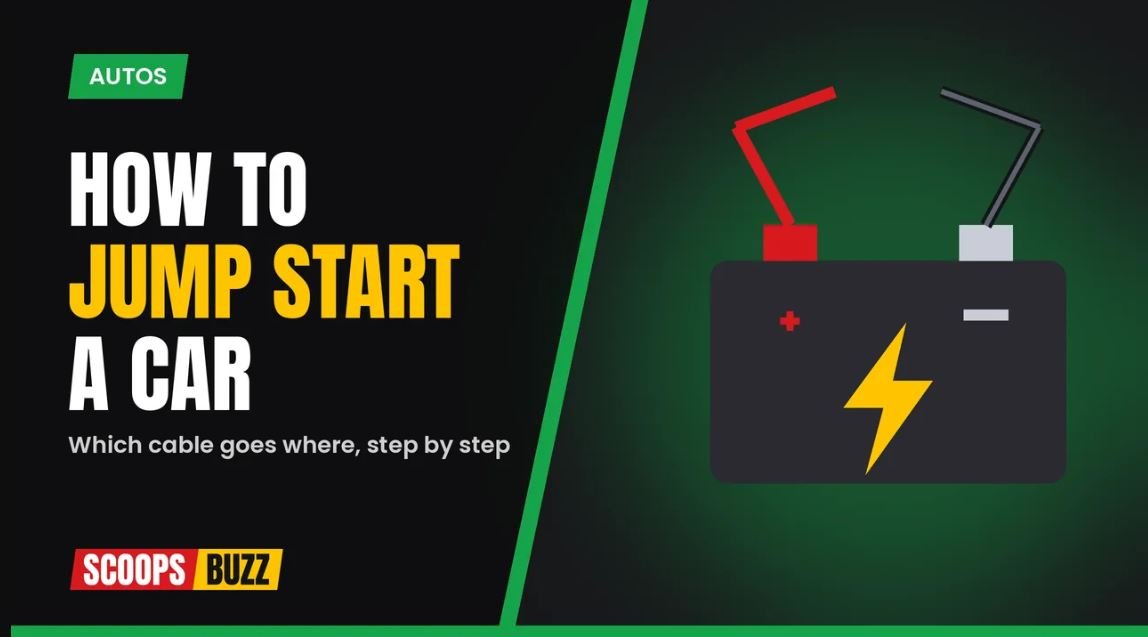
Connect the cables in this order: red to the dead battery, red to the good battery, black to the good battery, then black to bare metal on the dead car. Start the working car first, wait a few minutes, then try to start the car with the flat battery. Remove the cables in the reverse order once the car is running. Drive for at least 30 minutes afterward so the battery can recharge. Never jump start a battery that is cracked, leaking or frozen.
It is one of the most common car problems of all. You turn the key or press the start button, and nothing happens, or the engine makes a slow clicking sound. A flat battery can strike at any time, but it happens most often on cold winter mornings.
Knowing how to jump start a car can save you time, money and the stress of waiting hours for roadside help. It takes about 10 minutes and just a set of jumper cables or a portable jump starter.
Here is how to jump start a car safely, step by step, plus what to do afterward and when a jump start will not work.
Signs Your Battery Is Dead
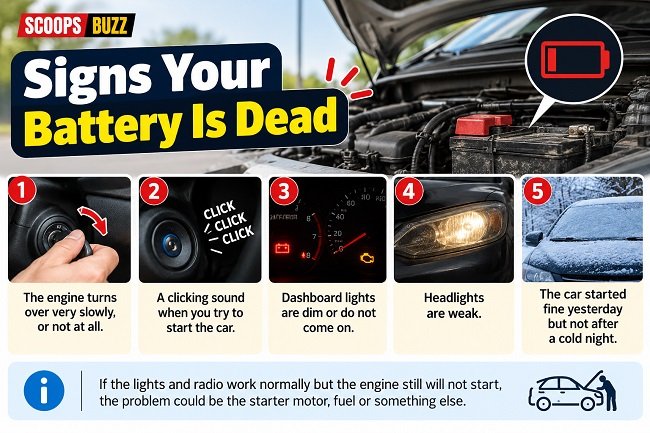
The first step in how to jump start a car is checking that the battery is the problem. Before you try to jump start a car, make sure the battery is really the problem. Common signs include:
- The engine turns over very slowly, or not at all
- A clicking sound when you try to start the car
- Dashboard lights are dim or do not come on
- Headlights are weak
- The car started fine yesterday but not after a cold night
If the lights and radio work normally but the engine still will not start, the problem could be the starter motor, fuel or something else.
What You Need
- Jumper cables (called jump leads in the UK), or a portable jump starter
- A second car with a working battery of the same voltage, usually 12 volts
- Safety glasses and gloves, if you have them
- Your owner’s manual, which may show special jump points
How to Jump Start a Car With Jumper Cables
🚗 How to Jump Start a Car With Jumper Cables
Follow these 8 simple steps to safely get your car running again.
Position the Cars
Park the working car close enough for the cables to reach both batteries. Keep the vehicles from touching. Switch off both engines, apply the parking brakes and select Park or Neutral as appropriate.
Turn Everything Off
Switch off headlights, radio, heater, phone chargers and all other electrical accessories in both vehicles before connecting the cables.
Find the Batteries and Terminals
Open both hoods and locate the batteries or designated jump-start points. Identify the terminals:
- Positive (+): Usually marked with a plus sign and a red cover.
- Negative (−): Usually marked with a minus sign and a black cover.
Check the vehicle manual if the battery is not under the hood.
🔌 Step 4: Connect Jumper Cables in the Right Order
Important: Keep the clamps from touching each other or other metal surfaces. Follow your vehicle manufacturer’s designated grounding-point instructions.
Start the Working Car
Start the vehicle with the good battery and let its engine run for approximately 2–5 minutes, or follow the manufacturer’s instructions.
Start the Car With the Dead Battery
Try starting the vehicle with the flat battery. If it does not start, wait a few more minutes and try again. Stop if it still fails after a few attempts.
🔄 Step 7: Remove the Cables in Reverse Order
- Remove the black clamp from the grounding point on the jumped car.
- Remove the black clamp from the good battery.
- Remove the red clamp from the good battery.
- Remove the red clamp from the jumped battery.
Keep the loose clamps separated and away from metal surfaces while disconnecting them.
Keep the Engine Running
If the vehicle starts, keep it running. A drive of around 30 minutes may help recharge the battery, but a proper battery charger is more reliable. Short trips may not provide enough charging time.
Never jump-start a cracked, leaking, swollen or frozen battery. Do not attempt this procedure if the vehicle manufacturer prohibits it. Hybrid and electric vehicles may have special jump-start procedures.
If your car repeatedly needs a jump-start, have the battery, alternator and charging system tested. A jump-start may get you moving, but it does not fix the underlying problem.
This is the classic method and works with almost any vehicle.
Step 1: Position the Cars
The first practical step in how to jump start a car is getting the vehicles in place. Park the working car close to the car with the flat battery, so the cables can reach both batteries. The cars should not touch each other.
Turn off both engines, put both cars in Park or neutral with the parking brake on, and remove the keys.
Step 2: Turn Everything Off
Switch off headlights, the radio, heater, phone chargers and anything else that uses power in both cars.
Step 3: Find the Batteries and Terminals
Open both hoods and find the batteries. Some cars have the battery in the trunk or under a seat, with special jump points under the hood. Check your manual if you are not sure.
Each battery has two terminals:
- Positive (+): Usually marked with a plus sign and often a red cover
- Negative (minus): Marked with a minus sign and often black
If the terminals are covered in white or green crust, wipe them gently with a cloth while wearing gloves.
Step 4: Connect the Cables in the Right Order
This is the most important part of learning how to jump start a car. Follow this order exactly:
| Order | Cable | Connect to |
| 1 | Red | Positive (+) terminal of the dead battery |
| 2 | Red (other end) | Positive (+) terminal of the good battery |
| 3 | Black | Negative (minus) terminal of the good battery |
| 4 | Black (other end) | Bare, unpainted metal on the dead car’s engine or a ground point, away from the battery |
The last connection goes to metal rather than the dead battery’s negative terminal because a small spark can happen. Keeping that spark away from the battery reduces the risk of igniting any gas the battery may give off.
Make sure the cable clamps do not touch each other while any of them are connected.
Step 5: Start the Working Car
Start the car with the good battery and let it run for two to five minutes. Raising the engine speed slightly can help charge the flat battery.
Step 6: Start the Car With the Flat Battery
Now try to start the car with the dead battery. If it starts, great. If not, wait a few more minutes and try again.
If the car still does not start after a few tries, stop. There may be a bigger problem.
Step 7: Remove the Cables in Reverse Order
Once the car is running, remove the cables in the opposite order:
- Black from the metal on the jumped car
- Black from the good battery
- Red from the good battery
- Red from the jumped battery
Do not let the clamps touch each other or any metal while removing them.
Step 8: Keep the Engine Running
Drive the jumped car for at least 30 minutes, ideally on a longer road at steady speed, so the alternator can recharge the battery. Short trips may not put enough charge back in.
How to Jump Start a Car With a Portable Jump Starter
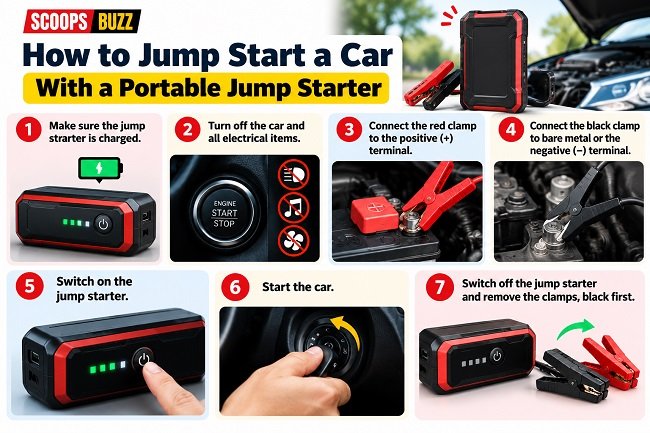
If you want to know how to jump start a car without help, this is the answer. A portable jump starter, sometimes called a jump pack or booster pack, lets you jump start a car without a second vehicle. Many are small enough to keep in the glove box.
- Make sure the jump starter is charged.
- Turn off the car and all electrical items.
- Connect the red clamp to the positive (+) terminal.
- Connect the black clamp to bare metal or the negative (minus) terminal, as the instructions say.
- Switch on the jump starter.
- Start the car.
- Switch off the jump starter and remove the clamps, black first.
Jump starters cost from about $50 to $150 in the US, or £40 to £120 in the UK. They are a smart thing to keep in your car in winter, and many can also charge your phone.
Safety Tips
⚠️ Car Jump-Start Safety Tips
Follow these six precautions before connecting jumper cables.
1. Check Battery Condition
Never jump-start a battery that is cracked, leaking, swollen or visibly damaged.
2. Avoid Frozen Batteries
Do not jump-start a frozen battery. Let it thaw safely and have it inspected first.
3. Keep Sparks Away
Keep flames, sparks and cigarettes away from the battery area while jump-starting.
4. Wear Eye Protection
Use safety goggles and protective gloves when handling batteries and jumper cables.
5. Check Battery Voltage
Make sure both vehicles use compatible battery systems and the same voltage, usually 12V.
6. Read Your Owner’s Manual
Modern cars, hybrids and luxury vehicles may have special jump-start procedures. Always follow the manufacturer’s instructions.
If you are unsure about the battery condition, connection points or jump-starting procedure, stop and contact a qualified mechanic or roadside assistance service.
Safety matters every time you jump start a car.
- Never jump a battery that is cracked, leaking or bulging.
- Do not jump a frozen battery. If you see ice or the sides are swollen, it could explode. Let it thaw first.
- Keep sparks and flames away. Do not smoke near a battery.
- Wear eye protection if you can.
- Check the voltage. Both cars should use the same voltage battery, usually 12 volts.
- Read your manual. Some modern cars, hybrids and luxury models have special instructions.
Can You Jump Start an Electric or Hybrid Car?
Electric and hybrid cars have a large high voltage battery for driving, but they also have a normal 12 volt battery that powers the computers and lights. If the 12 volt battery dies, the car will not switch on.
Many EVs and hybrids can be jump started using the 12 volt battery or special jump points, but the process varies. Some manufacturers say their electric cars should not be used to jump start another vehicle. Always check the owner’s manual first.
Why Do Car Batteries Die?
| Cause | What happens |
| Cold weather | Batteries produce less power in the cold |
| Old age | Most batteries last about three to five years |
| Lights left on | Interior or headlights drain the battery overnight |
| Short trips | The battery never fully recharges |
| Car not used | Batteries slowly lose charge when parked for weeks |
| Faulty alternator | The battery is not recharged while driving |
| Corroded terminals | A poor connection stops power flowing |
How to Jump Start a Car Alone
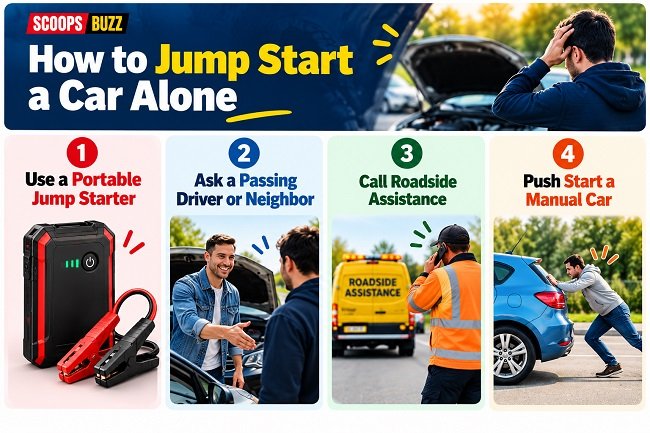
If no one is around to help, you have a few options:
- Use a portable jump starter. This is the easiest way to jump start a car on your own.
- Ask a passing driver or neighbor if they can help with jumper cables.
- Call roadside assistance. Many car insurance policies, credit cards and new car warranties include it.
- Push start a manual car. Some older cars with a manual gearbox can be started by rolling them in second gear and releasing the clutch, but this does not work with automatics and is not recommended for modern cars.
Choosing Jumper Cables
Not all jumper cables are the same. When you buy a set, look for:
- Thicker wire. A lower gauge number, such as 4 or 6 gauge, means thicker cables that carry more power.
- Length of at least 12 to 20 feet, so they reach between cars easily.
- Strong, well insulated clamps with a firm grip.
Keep them in your trunk all year, along with gloves and a flashlight.
What to Do After a Jump Start
🚗 What to Do After a Jump Start
5 important steps to protect your battery and avoid another breakdown.
Drive for at Least 30 Minutes
Keep the engine running and take a longer drive if it is safe to do so. However, driving does not guarantee a full battery recharge.
Get the Battery Tested
Visit an auto parts store or garage to check the battery’s health and charging capacity. Some locations offer free battery testing.
Check the Battery Age
Most car batteries last around three to five years, depending on usage and climate. An older battery may need replacement.
Watch for Dashboard Warning Lights
If the battery warning light stays on while driving, the alternator or charging system may not be working correctly. Get it inspected promptly.
Check for Repeated Battery Problems
If the battery goes flat again soon, ask a mechanic to inspect the battery, alternator and complete charging system.
A jump start is only a temporary solution. If your vehicle repeatedly struggles to start, do not ignore the problem. A proper battery and charging-system check can help prevent another breakdown.
A jump start gets you going, but it does not fix the cause. After you jump start a car:
- Drive for at least 30 minutes.
- Get the battery tested. Many auto parts stores and garages test batteries for free.
- Check the age of the battery. If it is more than three to five years old, it may be time to replace it.
- Watch for warning lights. A battery light on the dashboard while driving can mean an alternator problem.
- If it goes flat again soon, have a mechanic check the battery, alternator and charging system.
When a Jump Start Will Not Work
If the car still will not start, the problem may be:
- A battery that is completely worn out
- A faulty starter motor
- A broken alternator
- Loose or damaged battery cables
- An empty fuel tank
- A blown fuse
In that case, call roadside assistance or a mechanic. In the US, AAA and many insurance policies include roadside help. In the UK, the AA and RAC offer breakdown cover.
Keep Your Battery Healthy
The best way to avoid needing to know how to jump start a car is to look after your battery.
- Test your battery every winter, especially once it is three years old.
- Turn off lights and accessories when you park.
- Take a longer drive at least once a week.
- Keep the terminals clean.
- Use a battery maintainer if your car sits unused for a long time.
Our guide to winterizing your car has more tips for cold weather. The National Highway Traffic Safety Administration also shares vehicle safety advice at NHTSA.gov. For more background, see the jump start Wikipedia page.
More From ScoopsBuzz
- How to winterize your car: 15 winter car care tips
- Thanksgiving travel 2026: best days to fly or drive
Frequently Asked Questions
What order do you connect jumper cables?
Red to the dead battery’s positive, red to the good battery’s positive, black to the good battery’s negative, then black to bare metal on the dead car.
How long should you leave jumper cables on?
Let the working car run for two to five minutes before starting the dead car. Remove the cables once it starts.
How long should I drive after a jump start?
At least 30 minutes, so the battery can recharge.
Can a jump start damage my car?
It is safe if you follow the right steps. Connecting cables the wrong way can damage electrical parts.
Can I jump start a car in the rain?
Yes, with care. Keep the clamps and battery tops as dry as possible and avoid standing in deep water.
Why does my car keep needing a jump start?
The battery may be old, or there may be a problem with the alternator or a power drain. Have it tested.
Sources: AAA, RAC, AA, NHTSA, battery manufacturer guides